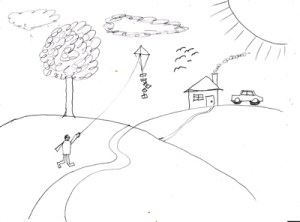
Exercising A Whole New Mind: Symphony

linedrawingbyCraig_Spence

drawing courtesy of Craig Spence

Symphony, fortunately, is not about musical ability.  According to Dan Pink its the ability to put together the pieces.  Capabilities such as: find patterns, cross boundaries to bring knowledge from one specialization to another, create metaphors, see the big picture.

My favorite exercises from this list:

  • Hit the Newsstand: buy mags you’ve never noticed before and look for ways to use the content in work or life.  I haven’t tried this, but I definitely want to.  May indeed be confusing for rest of family though…
  • Draw: Drawing on the Right Side of the Brain is the classic by Betty Edwards (I was lucky enough to get this from my mom in my teenage years).  Line drawing is such a meditative in-the-moment exercise – once you start concentrating time flies and you feel quite peaceful once you’re done.  And there’s that pleasure of rediscovering how to draw – you can still do art!  (BTW, the picture above is just one of the exercises, recreating a childhood drawing.  You can see others in Craig Spence’s photostream. You will actually learn to draw well from this book 🙂 ) Thoroughly recommended.
  • Follow the Links:  An argument for random surfing via U Roulette or Random Web Search (as if we don’t do enough of this already – the last thing I need is a right-brain exercise as justification!)
  • Look for Solutions in Search of Problems: could you take a solution and use it somewhere else, or flip the default to make it work?
  • Books: I’ve been wanting to pick up George Nelson’s classic How to See but that puppy is $75 used!  Thanks DWR.
  • Brainstorming: Pink summarizes the IDEO brainstorming technique from Ten Faces of Innovation.  I first tried this out back in 2007 when I was interviewing with IDEO and was working on a new car seat design.  Its amazing: had about 10 friends over and 30 minutes later, 100 novel ideas which you cull later.  The basics: go for quantity over quality,  encourage wild and crazy ideas, defer judgment, and use pictures and change the focus when the ideas slow down.

Tomorrow, time for some Empathy.  Have a good one.

Exercising A Whole New Mind: Story

photo courtesy of Nufkin

photo courtesy of Nufkin

The second of Dan Pink’s six right brain senses is Story.

Story
Chip and dan Heath convinced me of the importance and power of Story in Made to Stick which I thoroughly recommend as a handbook for creating communication people will remember.  I’m not sure if it is because Pink was a speechwriter and is now a writer, but I find these exercises less attractive.

What’s your 50-word story? Some of the other ideas I’m not personally motivated to try: enlist in StoryCorps, tape record a friend or relative’s story, got to a storytelling festival, subscribe to OneStory, try telling a digital story, read texts on storytelling.  There are a few fun ideas here though:

  • Write a mini saga: 50 words long on your life or something that happened. Henry Olson introduced me to this great quote from Blaise Pascal: “I am sorry for the length of my letter, but I had not the time to write a short one.” Editing 2000 words down to 1000 is actually more time consuming than writing the 2000 words.  50 words really focuses your attention on just what’s important
  • Riff on opening lines: at a party, throw a bunch of opening lines from books into a bowl and draw cars and construct stories from them.  I’ve played a very fun variant where one person reads the description on the back of a book, then writes down the first sentence.  Everyone else makes up a first sentence.  The real and made up lines are thrown into a bowl, read out loud, and you have to guess which is the real one.  Very amusing.
  • Play Photo Finish: similar but show pictures and have people come up with a story.
  • “Who Are These People?”: look at people in public and try to make up a life story for them.

If you want to learn how to write more memorable stories, go with the Heath brothers’ advice, if you want to learn how to write well, then Pink’s suggestions are useful.  I’m surprised he doesn’t mention blogs or writer’s festivals.

Tomorrow we look at symphony.  Fortunately its not just about music.

Exercising A Whole New Mind: Design

photo from Wired posted by Wiley Chin

photo from Wired posted by Wiley Chin

I’ve just finished Dan Pink’s, A Whole New Mind: Why Right Brainers Will Rule The Future. As a right-brainer who woke up a few years ago realizing how I’d been neglecting my creative side, and that I needed to re-engage it to increase my personal well-being, I was both thrilled at the prospect of the ascendance of the Conceptual Age (replacing the Information Age) and motivated to accelerate the role of the right brain in my life.

One of the great aspects of Pink’s book is the Portfolio section at the end of each of the Six Senses of the Conceptual Age: Design, Story, Symphony, Empathy, Play, Meaning, to complement the left-brain predilections for Function, Argument, Focus, Logic, Seriousness, and Accumulation respectively.  Why these are the right six senses he doesn’t explain (no doubt frustrating to left-brainers), but they certainly feel like a good list. After describing each sense he provides a host of practical exercises you can undertake to engage them. I’m not going to review the book itself in great detail, as that is readily available elsewhere. Instead I’ll focus on sharing the results of my experiences with these Portfolio activities, which may be helpful for others interested in upping the role of the right brain in their lives.  There’s a lot of experiments for each sense, so I’m going to break this into six posts.

Review Summary: I Loved It (But I’m Biased)
Clearly I’m pre-disposed to believe the central thesis, which I find to be self-evident. For left-brain cynics Pink has a whole chapter of evidence. For those who think in black and white (as opposed to my preferences for shades of gray) I’d stress that he’s not saying there is no place for the left-brain, and that’s precisely why he called it A Whole New Mind. Pink is arguing that more use of right-brain skills will be more highly valued in the new world order. There will still be bankers and accountants. And anyone who can combine both will have the potential to enjoy the best of both worlds.

In terms of the book itself, Pink writes extremely well and/or has a fabulous editor. It’s a very easy read, well-structured, peppered with humor, and absent the frustrating, endless repetition typical of so many business books.

Portfolio Review: Testing the Senses

None of these will turn you into a creative guru overnight.  I see them really as just fun exercises that help you to re-connect with the right brain and find what works for you.  Turn what you like into a habit and forget the rest.

Design

  • Design Notebook: use to note good and bad design. Great training for the eye. I’ve already accumulated some blog topics on this one.
  • Channel Your Annoyance: sketch up a solution to bad design and mail to manufacturer. I’m going to try this with yoghurt tubes, juice boxes, and gym equipment. It’s quite cathartic to determine what annoys you and actually do something about it
  • Read Design Magazines: As a retired architect, I already subscribe to a range of architectural porn including Metropolis and Dwell. I think Pink forgot Sunset which is a delight for all the senses. I miss Real Simple for its overwhelming sense of calming layout and life organization (the magazine, not the website!), but I found it was just too overtly targeted at women, which was a little alienating –  maybe its time to see if this has changed.
  • Be Like Karim: excerpts from Karim Rashid’s manifesto are immensely appealing – to a generalist, starting with “#1. Don’t specialize” was a breath of fresh air in a world that overly favors specialization. I loved “Know everything about your profession and then forget it all when you design something new.” and “Normal is not good”
  • Participate in the “Third Industrial Revolution” – create a product tailored just for you.  Used NikeiD once for Christmas which was very popular.  Quite like doing custom t-shirts, calendars etc for gifts.   For 3-D design I’m really excited about the falling cost of design software (e.g. Google SketchUp) and availability of 3-D printing for prototypes.
  • C-R-A-Pify Your Design – a few minor hints on cleaning up the visual appearance of materials you develop – we’ll have to talk about PowerPoint’s another day – huge topic.  Once you know what look for cleaning up a PowerPoint is actually pretty easy. Start with consistent colors and fonts and alignment of elements on a page. Removing all the unnecessary slides, removing all the crap from the slides and endless bullets is key. Strongly recommend Garr Reynold’s Presentation Zen and Nancy Duarte’s slide:ology.

What experiments have you tried and with what results?

The Knowledge Management Holy Grail

photo courtesy of Eddi 07

photo courtesy of Eddi 07

For the 15+ years I’ve been working in knowledge worker roles, knowledge management has been much spoken about, but never seen.

I’m currently working with a virtual team of nearly 10 consultants.  The firm has had 0ver 80 clients since its founding in 2001, so there is a treasure trove of experience in the firm.  Unfortunately, its in people’s heads, on their laptops, and to a lesser degree on the shared network drive.  Sound familiar?  It’s the classic enterprise knowledge management problem.  You want to tap into the experience of your peers, but there is no easy way to do it.

For example, if I need to run a requirements session, and I know my colleagues have done many, I currently have to phone each one and rely on their memory and availability to send me what they have, or I can browse through the network client folders one-by-one randomly opening documents.  Inefficient and time-consuming.    A Google appliance would help, but the success of that approach depends on the discipline to save relevant files to the network drive.

We need a system which reduces the barriers to storage and search – organization with minimum overhead.  It seems the new abundances of storage, computing power and bandwidth would be amenable to cracking this decades old problem.  Perhaps a version of Google that can search nominated folders and Outlook files on everyone’s laptop that’s working on the same project? How cool would it be if you could just do a Google quality search of the team members’ laptops, maybe with an interrupt alert that seeks their approval of which folders and what results to share? Even cooler if a wiki or other centralized collection of notes and links was auto-created and updated on desired topics again with people’s approval of the search and results.  Any takers? (We could certainly use the help!)

10 Years, 10 Lessons: Year 10: You Reap What You Sow

Enjoying the wildflowers

Enjoying the wildflowers

The No Asshole Rule and why you should smell the roses

The valley is small.  Your target market is probably smaller.  The internet doesn’t forget, and nor will your network.  More than ever before, people don’t have time to find the perfect candidate.  In this Reputation Economy, inter-personal bridges you have burned will come back to haunt you, and relationships you’ve nurtured will keep bearing fruit.  So, be nice (and helpful). Please.

I don’t know if it’s a function of my age, but I’ve had plenty of reminders recently that life can change at any moment.  This is surely the best reason for enjoying it to the fullest. Don’t take yourself or your work too seriously.

Key Takeaways: Carpe diem and nurture your network.

Sign Posts: Has anyone left because of a difficult co-worker or boss? What is the company doing to help the greater community?

Summary

This concludes the 10 years, 10 lessons.  Hopefully there were a few nuggets in there.  Let me know what you think!

10 Years, 10 Lessons: Year 9: On the Way Down, the First Offer is the Best Offer

photo courtesy of jakerome

photo courtesy of jakerome

Just take it!

When you’re on the way down (you can smell death in the hallways) the first offer you get will always be the highest.  In a failing startup, you lose value quicker than a laptop.  Market sentiment writes off the brand and talent leaves. It can take months to complete due diligence, and months can be significant if cash burn is eroding equity, so take the first reasonable offer.  I know of at least one start up that sold 12 months later for a third of the first offer.

Key Takeaways: When you’re on the way down, sell to the first real bidder.

Sign Posts: How would you characterize the momentum of the company? Is the company for sale?

10 Years, 10 Lessons: Year 8: Enterprise Software is Dead

photo courtesy of Tony the Misfit

photo courtesy of Tony the Misfit

User experience is a necessary organizational capability

Obviously, companies will keep buying software.  But the opportunities for a new SAP or Seibel are few and far between.  I ran a session on this at P-camp 08 last year, and the group was pretty vocal – the traditional software model has to change.  The consumer software market has lifted the bar for expectations for enterprise software: it should be easy to use, offer fast screen response times, constantly improve, and be much, much cheaper.

Customers don’t want:

  • To be sold software by the equivalent of a car salesman that can’t even remember their name after the ink has dried on the contract.
  • Implementation services that focus on the plumbing rather than adoption
  • Training that doesn’t teach them how to fish
  • Non-intuitive user experience
  • To hear that they’ll have to wait a year for the next release to get that desired feature
  • To hear that their infrastructure that is causing poor performance.
  • To hear that they have to upgrade their windows platform, or upgrade to an enterprise version of Oracle to use the software
  • Support that requires them to run a server log to diagnose the problem.
  • Support staff that don’t understand their business.
  • Upgrades that are “free” as part of maintenance but end up costing cost nearly as much as purchase “because” of their customizations and deliver no tangible business value.

Mission critical applications can probably still get away with a poor user experience. Everywhere else the consumer revolution is chipping away at the enterprise software kingdom.  Edge Dynamics won when we had a mission critical application.  As soon as the market changed to a nice-to-have reporting tool, everything we had built became a liability – bad user experience, slow performance, costly upgrades, huge upfront investment, costly upgrades

Key Takeaways: Enterprise software vendors need to stand in their customers shoes and design a “whole product” experience, and total cost of ownership that is significantly better than the alternatives.

Sign Posts: What improvements would customers like to see to your sales process, implementation, training, and support services and to your product? What are the alternatives to your solution?

10 Years, 10 Lessons: Year 7: Change or Die

photo courtesy of asw909

photo courtesy of asw909

It’s not them, it’s you

Often startups can’t understand why they have a group of customers they didn’t expect or who want to use the product in a way they didn’t anticipate.  Don’t fight the power – change.  Particularly when you are creating a new category, it is essential to get it out there early and get user feedback. If you build a perfect solution because you think you know who the customer is and what they want, you will find it is difficult to change when you learn your initial assumptions were wrong.  Founders At Work (as Guy Kawasaki suggested, it really should have been called Flounders At Work) is full of examples of startups launching a product, stumbling, realizing what the market really wanted and revising their offering to suit and then enjoying market success.

A shout out is due to Eric Ries of Startup Lessons Learned for his concept of The Pivot – that critical point when you must change the business to match what the market needs.  I’ve experienced this first hand with Edge Dynamics.  When the market changed structurally, and we finally realized it, our product was way too complex to be easily changed.  We needed to either stay in a shrinking high end market, or change our entire organization for the new reality (to change from mission critical enterprise software to nice-to-have reporting application best delivered as Software as a Service).  We dithered and died.  Abilizer did this better, cutting to the bone and re-launching (in this case from SaaS application to enterprise software).  In both cases, we proved that SaaS and enterprise software are two completely different businesses.  You can’t be both and to change from one to the other is very, very difficult.  The failure of hybrid software delivery business models is another example of the need to Focus!

Key Takeaways: Get the simplest, cheapest, bare bones product in front of customers as fast as possible and learn what they want. Then build the product they really want.  You’re either offering SaaS or software – don’t try to do both.

Sign Posts: How do you decide what features your customers need? Who makes the decision on what to include in the next release, and using what criteria? Do you offer on-premise and on-demand software?

10 Years, 10 Lessons: Year 6: If You Can’t Find the Right Person, Don’t Hire

photo courtesy of franckdethier

photo courtesy of franckdethier

Bad choices are worse than no hire

In a startup, the team is the biggest determinant of output and day-to-day happiness. Choose wisely.  You’re going to be effectively married to these people around the clock for years on end.  If something bothers you during the interviews, or the salary negotiations, don’t hire!  Any issues will be magnified a thousand-fold, and getting people out is painful and risky.  I hired someone who performed brilliantly in interviews, but became unnecessarily high maintenance during the negotiations.  Big mistake.

It has been said that you get ahead with A-players, tread water with B’s and go backwards with Cs.  My output and that of my team and our reputation definitely suffered due to this mistake at a critical time in the company’s development.  While it can be very hard to find the right person, it is always worth the wait. Don’t be suckered into settling for less, especially in today’s market.

This is a really challenging issue for most startups, because most startups, be definition, can’t be A-list.  There’s a limited number of killer ideas in growth markets addressed by well-funded, brilliant teams who are awesome fun to work with, have a great office, pay and perks.  Most startups have a least one blemish and the challenge for potential employees is working out which blemishes they can live with.  Likewise for a startup, finding and attracting the perfect talent is hard, and deciding what blemishes you can live with is crucial.

I’ve noticed a tendency amongst startups to put too much weight on experience in the market the startup operates in (anyone remember those hilarious posts in 2000 requiring 10 years of Internet experience?). You don’t hire IDEO or McKinsey for their prior expertise in the space, and I think the same thinking should apply to employees.  From what I’ve seen in both marketing and consulting, an A-player will get to know the space better than most on the team within 6 months of starting, and the right attitude and inter-personal skills, together with the boost in creativity from new thinking from other industries will outweigh the slight improvement in productivity of the experienced B player in months 0-6.  It’s clearly helpful to have some experts on the team, but I’d argue that always hiring experience over potential is an error.  Seth had a good post today on the tendency to prefer apparent risk over actual risk – what seems more risky can actually be less risky.

In that highly successful book, Good To Great, Jim Collins argued for “getting the right people on the bus, the wrong people off, and the right people in the right seats”.  He has posted some helpful mp3s on this topic. About ½ the VC’s I’ve heard, on the excellent iinnovate podcasts from Stanford’s Business and Design schools, say that they’d rather have a good team with an ok idea.  Amusingly, the other ½ say they’d rather have the average team in the killer market over the A-team in the bad market.  That said, my experience suggests you have to win the race your in, and the race has to be worth winning).  A good team will increase the likelihood of winning the race your in.

Key Takeaways: Get the right people on the bus. If you make a mistake, act quickly to resolve it.

Sign Posts: Has it been easy to find the right people? How do you find and evaluate them?

10 Years, 10 Lessons: Year 5: You Don’t Know What Your Customers Want

photo courtesy of clairity

photo courtesy of clairity

Keep talking to customers: you know you should

It’s one of the toughest problems in enterprise software.  It is really hard to find time to meet with customers and get quality feedback.  You have no choice.

When you’re launching a new type of product, its quite likely customers don’t even know what your talking about. At this point you have the vision and are hoping to deliver something useful enough that they’ll get it too.  In these initial stages, companies I’ve worked with talk to prospects initially to understand their needs and define the market.   Once you have something to address these needs, companies typically spend a lot of time with the first few customers getting putting the solution in place and training the users, and testing and refining Release 1.  This is good.   Its after this point, in the initial growth phases, when time and resources are strained that this discipline seems to just slide away.  Just because you knew their business better than they did at that point in time, doesn’t mean you’ll know it better from that point forward.

Every customer is different, and their business and their needs will keep changing. So you have to keep making the time to get the feedback.  It’s also the only way you will hear about new problems that may provide opportunities for differentiation.  While new web tools offer ways to facilitate interactive discussions without costly face time to improve and refine existing offerings, you will need to be on site, watching them work to spot the bigger opportunities.

At Edge Dynamics, we assumed we knew our customers after we had spent time on site with them through the first three implementations.  Around that time the market changed structurally.  We didn’t create a dialogue with our customers (once a year user group meetings are not a dialogue).  As we stayed in the ivory tower designing and pumping out ever more complex features, customers became overwhelmed with the feature set and started looking for something simpler.

Key Takeaways: Make time for customer interaction.  Keep your eyes open for structural changes, and opportunities for new products and differentiation.

Sign Posts: How do determine what customers need?  How do you involve the customer in the product design process?